
Family Worship Changed Our Life (in at Least Six Ways)
Contents
1. Family Worship Concretised My Role in the Family
2. Family Worship Blew Open My Imagination for What Family Discipleship Can Entail
3. Family Worship Structured Our Spiritual Disciplines
4. Family Worship Deepened Our Worship on the Lord's Day
5. Family Worship Increased Our Love of Singing
6. Family Worship Has Kept Us Close to God
Introduction
Family worship has changed our life in at least six ways. But first, a quick definition: I’m talking about a practice that was popular among the Puritans (English protestants dissatisfied with the degree of reform in the Church of England, and, later, Scottish Presbyterians, a combination of whom end up shaping the religious life of the American colonies) from the time of the Reformation (16th century) but especially in the 17th century.
We have with us today the remnants of family worship in what many would call "family devotions." Family devotions are good. I wouldn't want to discourage anyone engaged in them. But one way of getting at family worship is by distinguishing it from family devotions.
Chief among the distinguishing features would be that family worship is appointed (read: required) by God to be performed in Christian homes. So it’s not optional, like a family devotion is normally understood to be.
Family worship understands the family to be a unit before God, brought before God by the head of the household, for actual worship. And by worship here I mean sacred practices, concrete duties (“sacred actions religiously and ordinarily performed to God’s honour, by the head of the family, with the rest… by God’s appointment.” Baxter). The offering of prayers, the singing of songs, the receiving of the word Christ, in the home. There is a weightiness to this, a regularity, and potentially, a thoroughness of what can be done in family worship that might not normally be present in family devotions.
So we are talking about the daily coming before the Lord, as a family, for teaching, prayer, and praise. And all this as a household belonging to God, and offering up to God these moments as family worship.
Family Worship Concretised My Role in the Family
Even if you believe Christian fathers have a unique responsibility to daily place spiritual food before their family, care for their souls, train them, encourage them, correct them (which not everyone does), without regular opportunities, these practices can become more theoretical than practical. Or they may become practices only when convenient.
But family worship has put me in a position to move toward my family with spiritual direction, with teaching, with encouragement, daily. It is the most purposeful work I have ever done, by far.
It has also changed the way the children see me in the family. A little while ago they were joking that 'Mama makes the dinner and Dada reads the Bible.' And I realized that without being told, our young children have noticed that in our home Mama and Dada have particular labours for the family. In this case they are recognising their parents feeding them. Both parents are providing sustenance. One, the sustenance of the body, the other, the sustenance of the soul.
Family Worship Blew Open My Imagination for What Family Discipleship Can Entail
This is a larger truth about teaching large quantities of the Bible slowly, over time, and in some sequence. But it is particularly noticeable in family worship. We have covered a lot of ground in five to six years. We’ve been through each gospel at least once. We’ve been through Judges, 1-2 Samuel, 1-2 Kings, Genesis, Ezra, Nehemiah, Ruth, Jonah, Acts. At the time of writing we are taking our first trip through Romans, moving very slowly.
And what I’ve discovered is I can teach the children about every aspect of life moving through (and around) the Bible in this way. Some examples. I never thought we would talk so much about politics around the dinner table with children all under 10. But in Judges we had numerous opportunities to think about the consequences of lawlessness in a land, of life without a King. In Genesis we did a lot of craft work because I wanted the kids to learn that our God is the God who made the universe. He is huge; so much bigger than we could grasp. So for several evenings we had foam planets rolling between plates on the dinner table.
At a certain point the children began asking about the historicity of our faith. So, to the resurrection! We spent several evenings in the resurrection passages of the gospels, interacting with “objectors” I had named according to their alternative theory. We met "Roland Bodhe," who believes Jesus' body was probably stolen. We met "Lucy Nation," who believes the disciples probably hallucinated the resurrection appearances. We met "Wong Tu," who believes the disciples simply visited the wrong tomb on the third day. We met "Lee Ping," who believes that Jesus slept through the crucifixion (the Muslim view). And we met "Gord Tory," who believes that the whole thing is just a good story, a legend that has arisen (!) over generations of oral tradition. Suffice to say at the end of each of these lessons the witnesses (the Apostles) were triumphant and the objectors defeated: God raised Jesus from the dead.
Recently we introduced some small payments for household duties that require some commitment or strength, including a bank (yours truly), with very generous interest rates, to encourage saving. But this meant we needed to spend some evenings listening to God about money. One evening was spent on the Owner of our money (not ourselves, but God), one on the priorities of our money (not always what one assumes), one on the dangers of money (that it enables us to acquire what we desire… which isn’t always right and good).
In all these adventures, and others besides, we discovered that we can bring all of life under Christ through consistent exposure to the depth and breadth of Scripture at family worship.
Family Worship Structured Our Spiritual Disciplines
I would like to believe that we would have found a way to pray consistently without family worship. But, several years in, I’m convinced we would not have prayed together nearly as much without family worship. The same goes for reading Scripture and singing together. The same goes for simply discussing theological things. This is because family worship has elevated and prioritised these things in the family routine. It has lifted them above the status of other regular family activities that come and go with our excitement and availability.
Our family worship has developed into a three tier system. As an aside, this is one of my favourite things about family worship. It is both a fixed commitment that (ordinarily) can’t be postponed, and a collection of practices that can be configured and tailored to our needs and stage of family life. Tier one: Evening Family Worship. This is our main meeting, because this is the meal we spend the longest at the table for. It is also because the evening is fitting for reflection and application with the adventures of the fading day fresh in mind.
Evening Family Worship is well suited to formation: the learning of new things, the systematic working through a thing, open discussion, back and forth. We do reading and teaching, catechism (the Shorter Catechism), often a history tidbit (on account of our interest in classical education), or perhaps a small chapter from a Christian book, as well as singing and prayer. I do as much as I can, with attentiveness to circumstance, at Evening Family Worship.
Tier two: Morning Family Worship. These times are much shorter, because our window is smaller. But they are just as significant in a different way. In the morning I’m aiming at orientation; orientation for the day ahead, with its adventures, trials, opportunities. Normally, we have a (short) reading, prayer, and song (or just a chorus, if we’re running late). The Shorter Catechism is never far away - a blessing for its bite-sized arrangement.
If I need extra help I’ll read to us a page from a devotional (at the time of writing it’s Spurgeon’s Chequebook of the Bank of Faith). Or we give our attention to whatever we’re up to in Bible memorisation, and that’s sufficient for the Scripture element of our morning. After saying the verses a handful of times I usually can’t resist making a comment about them. And with that, we are oriented.
Tier three is basically The Lord of the Rings. Tier three is Saturday Family Worship. At the moment the children enjoy a sleep-in competition on Saturdays, so breakfast is informal and flexible. But at lunch and dinner I will read from LOTR, wherever we’re up to, at the dining table. Tolkien and Middle Earth are so rich that I usually have a theological comment to make, or a verse that comes to mind. So theology is never far away (nor is the Shorter Catechism), and oftentimes neither is Scripture.
My approach on Saturdays is to prepare the family for the Lord's Day. This means we turn the temperature down, accomplish less, and require less of each other. This prepares us well for a high output and input day on Sunday. Saturday is our pre-rest rest, and it has helped us sustain family worship daily.
Family Worship Deepened Our Worship on the Lord’s Day
This is a blessing I wasn’t expecting, and I am sure there are more reasons for it than I'm cureently aware of. One reason family worship has deepened our Lord’s Day worship is probably that we now spend a lot of time practicing. Because our family now receives a word from God, and offers up prayer and praise to Him throughout the week, when Sunday rolls around, we’re ready to go. Participating in the service is much easier for us, because we’ve been practicing all week. Listening to a sermon is quite achievable for the children, because they’ve been listening to teaching all week.
But more than that, I think, our Lord’s Day worship is deeper in particular because we have ordered our daily life to worship in general. I don’t mean just teaching the kids that they can worship God anywhere. There’s a sense in which this is true. I mean actual sacred practices of worship performed daily. I think it’s because we’ve prayed together all week that our family is able to pray well with the congregation on Sunday.
Because we’ve been hearing and saying the Shorter Catechism through the week our declaration of a doctrinal statement on Sunday hits deeper. We had been memorising the Nicene Creed for several weeks at one point, and then our church used it as the declaration for a season. The children were excited because they knew it and were able to participate well. They knew it by heart.
All this means since we’ve had family worship in place, Sunday worship doesn’t just pop up for us, it’s actually a culmination of what we’ve been doing together all week. Or, looking forward into a new week from Sunday, it’s a filling up of energy and sustenance for what lies ahead. On the Lord’s Day we do with the household of God what we’ve been doing daily in our own little home, with our own little household.
Family Worship Increased Our Love of Singing
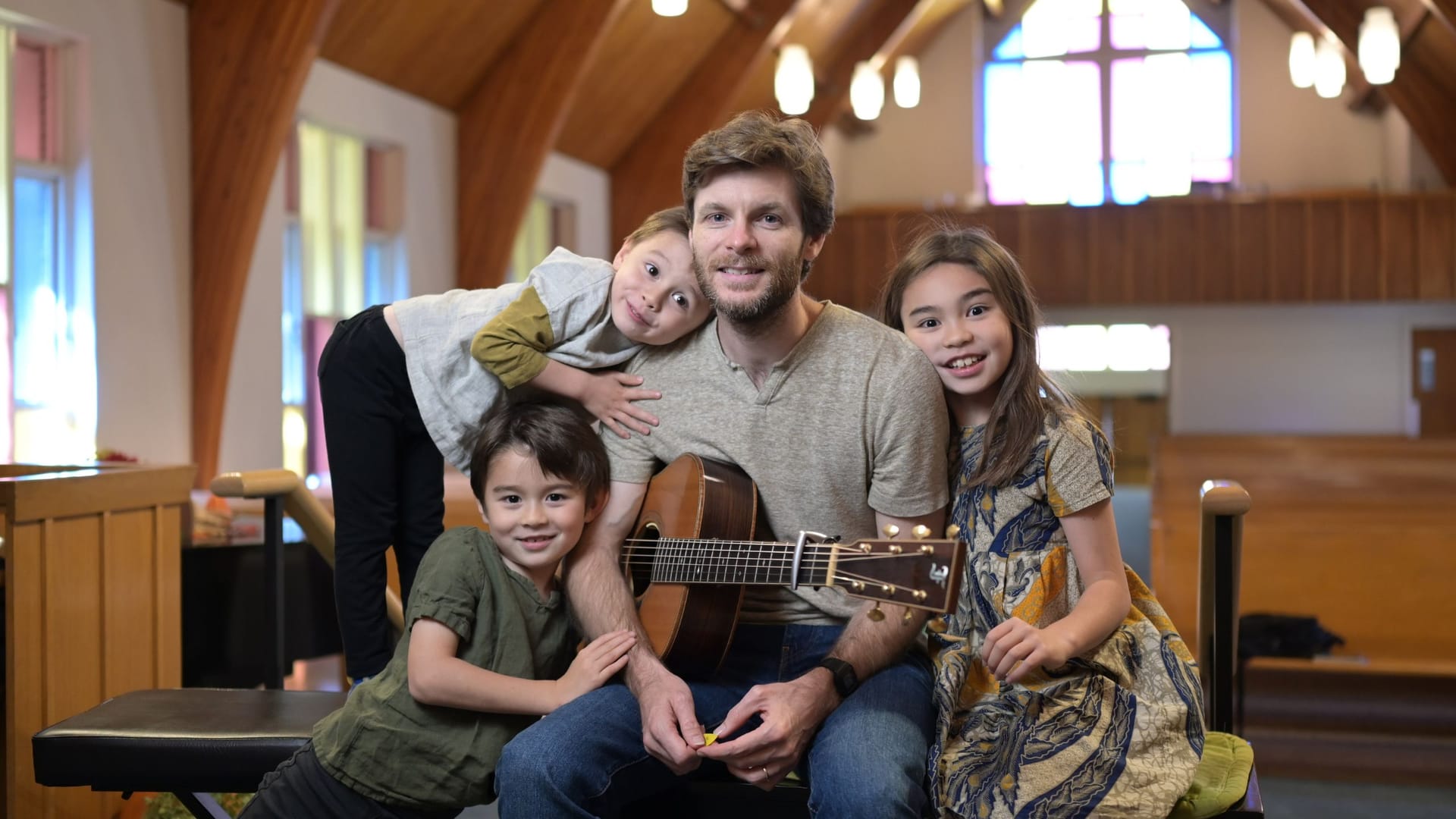
This is another blessing I wasn’t expecting. We are already a musical family, because I spent many years playing and singing professionally before coming to Christ. So we would listen to music a lot (kids love music), and I would lead us in songs from the guitar semi-regularly.
But the structured nature of family worship meant that we would sing daily. We would now sing certain songs every day. We began to really learn and know certain songs we were singing. And I could see some of them resonating deeply with certain children. Our singing become more pervasive in the home, but also more personal in the heart.
Recently, I put a hymn book in the middle of the table, with my little pile of family worship helps. And I was surprised that the children wanted to find songs they knew inside it, and read them as we sang. We started singing Come Thou Almighty King, which we didn’t know, and so we had to use the hymn book. This enriched our singing. Now the whole family is crowded around this hymn book, trying to read the lyrics as we sing. We also challenge each other to remember the verses across the week, learning new songs bit by bit, just as we memorise passages of Scripture.
And, to add to the previous point about the Lord’s Day, when a song comes up during Sunday worship that we’ve been singing at home, it hits differently. It becomes apparent that both households, the households gathered (the church), and the one around our dinner table, are joined up. The same thing happens in the other direction. We often take songs home from the Lord’s Day and incorporate them into family worship, where they put down deeper roots in us as we sing them daily.
Family Worship Has Kept Us Close to God
This all sounds like a great adventure, but on plenty of mornings and evenings I do not want to lead my family in family worship. Either I’m exhausted, or most likely it’s been a difficult day for us - there’s been a disappointment, or a conflict has just broken out around the dinner table. The temptation to turn away from spiritual things and either solve our problem superficially, or just ignore it until it goes away, is strong.
But family worship has kept us close to Christ in these moments, which is an incredible blessing. These are the moments we need Him the most. I simply would not bring my family before God on many of these days, without a duty to do so. If it were up to my feelings, or the circumstances, we would not be nearly as close to God, through the ups and downs, as we have been. And we owe this blessing to family worship.
I can think of times when I’ve been feeling discouraged, when everything in my mind and feelings is oriented away from my duty. But that’s the beauty of duty. It is established by another. And I’m called to it whether I like it or not. It’s good for me. It’s good for the whole family, whether we realise it or not. Family worship has meant we show up. We show up on the rainy days as well as the sunny days. And having shown up we entrust ourselves and our time to God, and He kindly receives and blesses our worship.
It’s been a significant blessing to us in recent years, and it’s not a surprise. All of God’s ideas for his people are blessings, in one way or another. Of course, I commend family worship to you! What else could I do?